First of all, who else but the servant or Macbeth himself would know where Banquo was? The servant was the one who brought the murderers into the room, and even though Macbeth says "Now go to the door, and stay there till we call." III.i.77, you'd imagine that a door is well within earshot. If he was listening in to the dirty details, he should be able to find them by himself. He was also the one who brought them in to meet with Macbeth, so he should also know what they look like. Even after calling Lady Macbeth his "partner of greatness" I.v.11, if he's unwilling to share his plan with her he probably wouldn't just go telling somebody else about it. That's why I don't think anybody else could've known the actual details.
Macbeth also questions the 2 murderers' manhood. "Ay, in the catalogue ye go for men;" III.i.100, This is important information because it shows that he doesn't have a lot of trust for them. Maybe Macbeth did actually send the servant to help with the murder because it was so important that both of them died.
The servant also knows some things that only a servant, or a least somebody who spends a lot of time around there would know (can't spell observing without serving). "Almost a mile; but he does usually-so all men do-from hence to the palace gate make it their walk" III.iii.17-19. I suspect that Macbeth doesn't have a ton of free time, so even he might not know the habitual route.
I don't think that the murderers would be able to tell that the attendant was the third murderer when they came to tell Macbeth that is was done, and there might have been some effort on his part to avoid this. First of all, the first time that the servant brought the murderers in he was stationed by Macbeth specifically to bring them in. This time, the murderer must have let himself into the castle and found his way to the feast by himself. Also, it was so dark that Banquo couldn't see, "Give us a light there, ho!" III.iii.12 the murderers didn't have a torch, (otherwise it would've been obvious where they were) so they might not have been able to tell anyways.
The end
Response to a classmate:
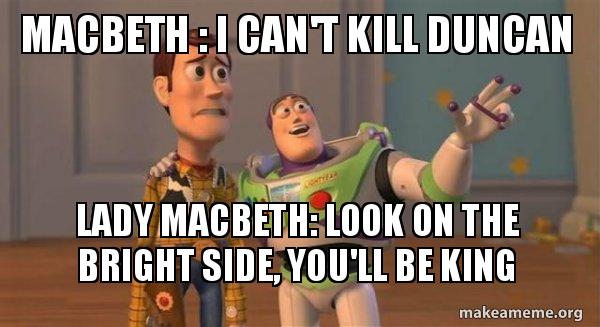
I found a point that Noah made rather interesting. He said: "This proves that Lady Macbeth is much smarter than her Husband. If Macbeth and Lady Macbeth are both that similar in ways that they think identical, Lady Macbeth would be able to figure out his plan". I disagree with this. First of all, Lady Macbeth doesn't even know the second part of the prophecy. When she reads Macbeth's letter, all he says is that he will be king, not that Banquo's son will be king. There's no reason for her to think that, and he even acts pretty normal around Banquo. Second of all, I don't think that Lady Macbeth is smarter than Macbeth. That's not to say that Macbeth is necessarily smarter, but I feel as if Macbeth's hesitance to kill the king, which he knew went against the chain of being, was a normal reaction and that Lady Macbeth's judgement was clouded by the opportunity for revenge. (I'd say that now that Macbeth is on his path to destruction, which he already knows he wouldn't be as paranoid as last time) She did mastermind the plan to kill Duncan, but Macbeth could easily do the same, and without her help (even if she were the 3rd murderer) she made sure that the murderers knew exactly when it would happen, where to go, and absolutely to kill both of them.
